
Journal · Carpets & rugs ·
Carpet and Rug Cleaning in Singapore: How Collection and Return Work
Most carpets in Singapore go years without being cleaned because of a logistics problem. A room-sized carpet weighs more than one person can carry and will not fit in a car, so the piece stays where it is. There are two ways around that: we collect it from your home, anywhere on the island, or you bring it to the Queenstown or Orchard shop. Either way it is washed and dried at our own facility and delivered back to you.
Getting it to us
Collection is the usual arrangement for anything room-sized. You book a time, we come to the house, and the carpet is rolled and taken away; when it is finished we bring it back and put it down where it was. Tell us roughly the size of the piece and what it is made of when you book, so that the right number of people arrive for it.
The alternative is to bring it in yourself. Both shops take carpets over the counter — Queenstown at 163 Stirling Road and Orchard at Far East Shopping Centre — and you can collect the piece there afterwards or have it delivered back to you. That works well for runners, prayer mats and small area rugs. For a dining-room or living-room carpet, collection is easier for everyone.
Why it is not cleaned in your living room
The service you are usually offered for a carpet is a shampoo done in the room, with a machine that agitates the top of the pile and draws some of it back. It is quick, and it cleans the top of the pile and nothing below it. There is no rinse, so the dust, grit and cooking residue it loosens settle back into the weave as the carpet dries. Dense pile also holds most of its soil at the base of the tuft rather than at the tip, and a surface machine never reaches that.
The water is the more serious objection in this climate. A carpet damp-cleaned in place stays damp deep in the pile and against the floor beneath it, in a room sitting at Singapore humidity, with no way to dry it under control. That is the condition mould and dust mites need, and it is a common reason a carpet smells worse a fortnight after being cleaned than it did before. Taking the piece away means it can be washed through properly and dried under controlled conditions, and it means your floor and underlay stay dry.
What happens once it leaves
Every piece is assessed before anything touches it: fibre, construction and how stable the dyes are. Wool, silk, synthetic and blended pile all behave differently, and a hand-knotted rug is a different proposition from a machine-made carpet. Old vegetable and aniline dyes in a hand-knotted piece are frequently not fully colourfast, so a dark border can bleed into a pale field if the rug is simply soaked. Which method a piece gets, and why, follows the same reasoning we set out in wet cleaning versus dry cleaning.
Dry soil comes out first. Most of what a carpet is carrying by weight is grit and dust rather than anything greasy, and taking that out before water is introduced is what stops it turning into mud in the pile. Then the piece is washed, rinsed through, and dried under controlled conditions rather than left to air in a humid room. That is the part that cannot be done in your house, and the reason the job takes as long as it does. The pile is finished before it goes back.
What it costs and how long it takes
Rugs and carpets are $8 per square foot, with a minimum charge of $200 per order, which is set out with everything else on the price list. Heavily soiled pieces, pet stains and delicate antique weaves can carry additional charges; those are assessed and confirmed with you before we start, never added afterwards.
Turnaround is about ten working days from collection. That is longer than a garment takes because the drying stage is the constraint, and it is not one to compress, because a carpet returned before it is fully dry will smell within a week. We confirm a timeline when we collect the piece, and if you have a date you need it back for, say so at booking rather than after.
How often it is worth doing
Every 12 to 18 months for a carpet in ordinary domestic use. The interval is shorter here than in a temperate country for the same reasons that run through most of what we clean in Singapore: humidity near 80% means the pile rarely dries out completely, windows open onto road dust, and a dense weave holds both. A carpet is also a large, still, absorbent surface in a warm room, which is the ideal habitat for dust mites, and a proper wash removes them along with the dust they live in rather than killing them and leaving them there.
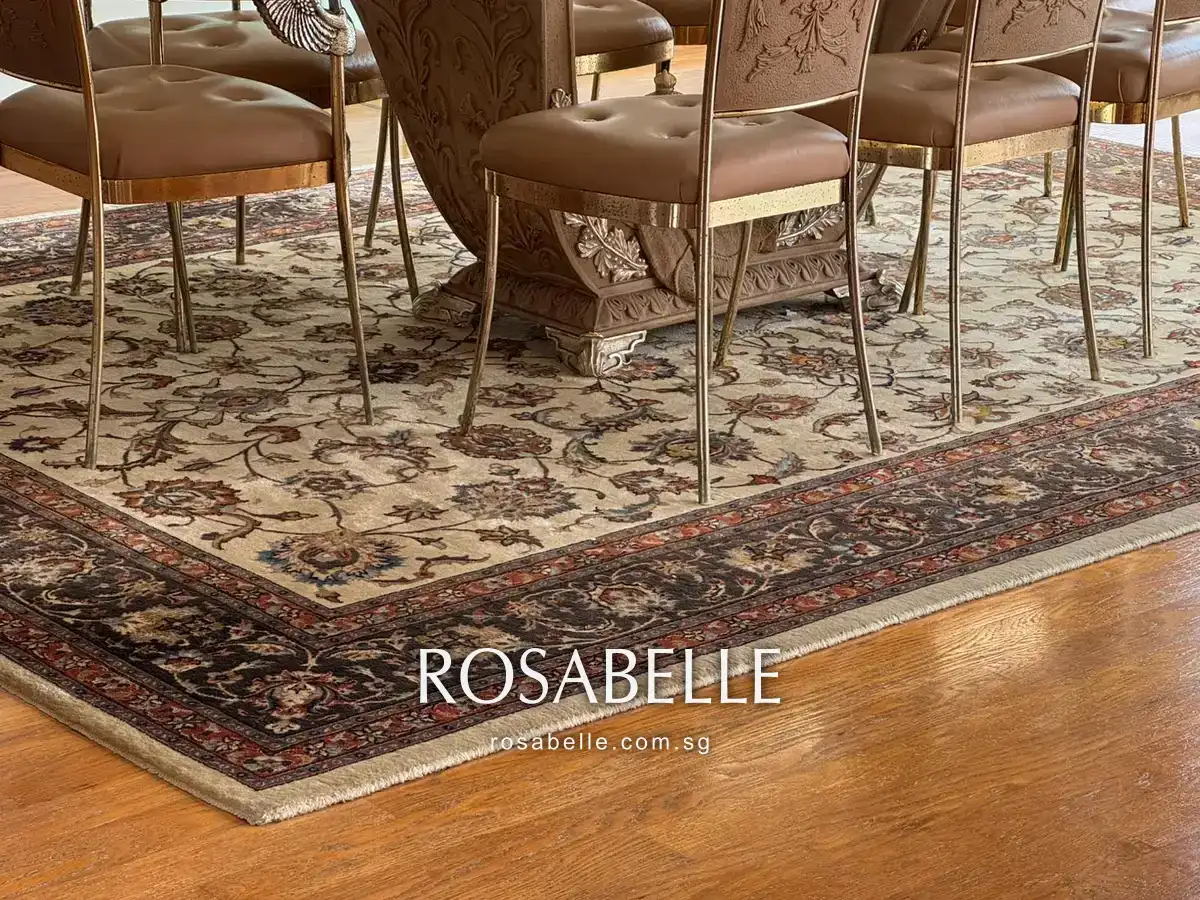
A dining-room carpet, like the one photographed above, usually wants the shorter end of that range. It takes food and crumbs, spills, and chair legs dragging across the same few square feet several times a day, and the soil concentrates in a band around the table rather than spreading evenly. The rest of the piece can look immaculate while that band is doing all the ageing.
The honest note
Cleaning removes soil; it does not undo wear. That difference is worth settling before a piece is collected. A proper wash takes out soil, dust and the mites living in it, and it will usually lift most of what has been spilt on a carpet. What it will not do is reverse wear: a pile flattened along a walking route stays flattened, sun-faded areas stay faded, and a fringe that has been vacuumed to pieces is a repair job rather than a cleaning one. Set-in stains on natural fibres carry the same caveat as all our stain work: most are treatable, not all are fully removable, and dye-based spills and pet accidents that have soaked through to the backing are the usual exceptions.
We assess the piece, say what we think is realistic for it, and quote for that. If part of it will not come out, you hear that before the carpet is collected rather than when it comes back.
Technical review: Zach Lim.
Related reading
More like this
Common questions
Frequently asked
Do you collect carpets and rugs from my home?
Yes. Islandwide pickup and delivery is part of the service: we come to you, take the piece away, clean it at our own facility and bring it back. For anything room-sized this is the usual arrangement, because a large carpet is heavy, awkward to roll and will not go into most cars. Book a collection and tell us roughly what size the piece is and what it is made of, so the right number of people turn up for it.
Can I bring my carpet to your shop instead?
Yes. You can drop a carpet or rug at either shop — Queenstown at 163 Stirling Road #01-1226, or Orchard at Far East Shopping Centre #B1-21 — and collect it there when it is done, or have it delivered back. Drop-off suits runners, prayer mats and smaller area rugs. For a room-sized carpet, collection from your home is almost always the easier option.
How long does carpet cleaning take?
About ten working days. Washing a dense pile properly and then drying it under control cannot be rushed without risking the fibre, and a carpet that goes back into a Singapore home before it is fully dry is how mould and a musty smell start. We confirm a timeline when we collect the piece, and heavier or more delicate carpets can take longer than the ten days.
How much does carpet and rug cleaning cost in Singapore?
Rosabelle prices by area, at $8 per square foot for rugs and carpets alike, with a minimum charge of $200 per order. Short nap and low pile pieces only. Heavily soiled pieces, pet stains and delicate antique weaves may carry additional charges, and those are always assessed and confirmed with you before any work starts. Islandwide pickup and delivery is available.
Why is off-site carpet washing more expensive than in-home shampooing?
Because the two are different jobs. An in-home shampoo is priced for a machine that agitates the top of the pile in your living room and then leaves: no rinse, no controlled drying, and nothing transported. Rosabelle’s rate covers collecting the piece, washing it through, rinsing it, drying it under controlled conditions and delivering it back, at $8 per square foot with a $200 minimum per order. On a small area rug the minimum charge makes ours plainly the dearer of the two. What the difference buys is the rinse and the drying, which are the two stages a machine working in your room cannot do.
Why can’t a carpet be cleaned in the room it sits in?
Because there is no rinse and no controlled drying in a living room. A surface shampoo lifts soil out of the top of the pile and then leaves it there, so the dust, grit and cooking residue that were loosened settle back into the weave as it dries. The bigger problem in Singapore is the water: a carpet damp-cleaned in place stays damp deep in the pile and against the floor underneath it in a humid room, and that is the condition mould and dust mites need. Cleaning off-site means the piece can be washed through and dried under controlled conditions, and your floor stays dry.
How often should a carpet be cleaned in Singapore?
Every 12 to 18 months for a carpet in normal domestic use. The climate is the reason the interval is shorter here than in a temperate country: humidity near 80% means a carpet rarely dries out completely, windows open onto road dust, and dense pile holds both. A dining-room carpet usually needs the shorter end of that range, because it also takes food, crumbs and chair legs dragging across it every day.
Can you clean a hand-knotted wool or silk rug?
Yes, and those are the pieces that most need assessment before anything touches them. Hand-knotted wool and silk rugs are often dyed in ways that are not fully colourfast, so a red or indigo border can bleed into a pale field if the piece is simply soaked, and silk pile is easily crushed or dulled by the wrong handling. We look at fibre, construction and dye stability first, tell you what we think is achievable, and price any extra work before we start. Antique and delicate weaves may carry additional charges.