
Bridal & formalwear · Singapore
Wedding Gown Cleaning & Restoration in Singapore
Rosabelle cleans and restores wedding gowns in Singapore, from gowns brought in the week after the wedding to yellowed, rust-marked, muddy and long-stored ones. Veils, the Chinese wedding kua and ma kua, saris, lehengas, sherwanis, cheongsams and formal suits are cleaned in the same workshop.
Every gown is inspected layer by layer, from fabric, lining and boning to beading, lace, hem and train, before the method, price and timeline are confirmed with you. Gowns are cleaned in-house at our Queenstown workshop and finished by hand.
A routine post-wedding clean starts from $190 and takes five working days and upwards. Restoration of set yellowing, rust or storage staining is priced after inspection and typically takes three weeks and up. Gowns go home in a hanging cover sealed top and bottom; we do not offer boxed preservation. Drop off at Orchard or Queenstown, or book islandwide pickup.
One dress, one chance.
Why wedding gown cleaning is different from regular dry cleaning
An everyday garment is one fabric, one construction, and one cleaning decision. A wedding gown is rarely fewer than four: an outer fabric, a lining, an interlining or net, and a structured bodice with boning channels running through it, often with beading applied by hand on top of all of them. Each layer can want a different method, and they are stitched together, so the method has to suit the most fragile part rather than the largest.
The soiling is different too. Champagne, perspiration, skin oils, hairspray and clear drink splashes can go into the fabric colourless and stay invisible for months. In Singapore's heat and humidity they can oxidise, and the cloth discolours around them — which is why the marks follow the wearer and the floor: the hem that swept the ground, the folded edges that took the handling, the facings that sat against skin. By the time a mark is visible it has been setting into the fibre for a long time.
Timing therefore matters more than most brides realise. Two weeks is the usual advice and it is good advice here; the sooner a gown comes in after the day, the better the outcome. A Vivienne Westwood gown that went into storage uncleaned shows where the delay ends up, and a satin train greyed by one evening on a ballroom floor shows how little it takes to mark a hem in the first place.
How much wedding gown cleaning costs in Singapore
Wedding gown cleaning at Rosabelle starts from $190 and rises with construction complexity and soiling: a simple silk slip is a different project from a heavily beaded ballgown with a hemline that swept a lawn. Beading, a long layered train, a boned bodice and heavy hem soiling each add to the figure, because each adds hours of hand work rather than machine time.
The final price is confirmed after inspection, never after the fact. If a gown turns out to need restoration rather than cleaning — lifting set yellowing, treating rust — we tell you what that costs and what it can realistically achieve before we begin. Restoration costs more because it is done in rounds rather than one treatment: a typical restoration takes three rounds or more, each round is left to dry and inspected before the next, and each gown is treated on its own by a specialist.Unstructured wedding dresses are $90; tuxedos and ethnic suits from $40. Veils are quoted after inspection, since length, layering and beading vary far more than the gowns they are worn with.
Gown service at a glance
- Assessment
- Every gown, layer by layer, before any work; price and timeline confirmed first
- Worked at
- In-house at our Queenstown workshop
- Finishing
- By hand, every gown
- Returned in
- A hanging cover sealed top and bottom
- Not offered
- Boxed preservation
- Drop-off
- Orchard or Queenstown
- Pickup
- Islandwide pickup and delivery
Guide pricing — from
- Wedding gownfrom $190
- Wedding dress$90
- Evening dress$45
- Veilon inspection
- Kua / ma kua / sari / lehenga / sherwanion inspection
What happens to your gown, step by step
Nothing here is a production line. A gown is booked in as its own job and stays that way until it goes home.
-
Inspection and a quote, before anything is touched
The gown is examined layer by layer — fabric, construction, boning, beading, the state of the hem and train, and any marks you have already spotted. This is where we tell you what the job is, what it costs and how long it will take. Nothing starts until you have agreed to it.
-
Spot testing on a hidden seam
Every treatment is tested on a hidden seam allowance first. Fibre, dye and age all decide what a fabric will take, and an aged silk will not take what a new one takes. Testing is what stops a treatment that lifts a stain from lifting the colour with it.
-
The hem and train treated first
Floor soiling is ground into the weave by the weight of fabric moving over it, rather than sitting on the surface. In our workshop the hem and train are released and treated as their own job before the gown is cleaned through, so the ground-in soil is lifted rather than spread through the skirt.
-
The cleaning method chosen for the gown, not the rack
Some gowns want dry cleaning, some want wet cleaning, and plenty want one method through the body and hand work at the edges. The decision follows the fibre, the trim and the soiling — our note on wet cleaning versus dry cleaning sets out how that choice gets made.
-
Stain work in stages, assessed between rounds
Set staining is worked in repeated controlled passes with the gown assessed between them, rather than pushed through one aggressive bath. A typical restoration takes three rounds or more, and each gown is treated on its own by a specialist. Crepe distorts if it is forced, and a distorted panel cannot be pressed back out.
-
Controlled drying
A layered skirt holds moisture between its layers, and uneven drying simply replaces the soiling with watermarks. Large gowns are dried slowly and under control so every layer dries at the same rate.
-
Hand-finishing, then a sealed hanging cover
Finished by hand, as every gown here is, so embroidery keeps its relief instead of being pressed flat and the drape falls the way it was cut to fall. The gown goes home in a cover sealed top and bottom, ready to hang.
Routine post-wedding cleaning or restoration?
Most gowns come in for one of two jobs, and they are priced and timed differently. We tell you which one your gown needs at inspection.
Routine post-wedding cleaning
For a gown brought in soon after the wedding: floor soil along the hem and train, perspiration and body oils at the bodice, makeup at the neckline, and drink splashes that may not show yet. From $190, rising with construction and soiling, and five working days and upwards. The satin train and the lace mermaid gown below both came in this way.
Restoration
For marks that have had time to set: yellowing through the fabric, brown along folds and hems, rust spotting, heavy mud, and gowns stored uncleaned for years. The work is done in stages, typically three rounds or more, with the gown assessed between rounds, is priced after inspection, and typically takes three weeks and up. Complete removal is possible on some gowns but cannot be guaranteed.
Vintage and long-stored gowns
An older gown with nothing visibly wrong can still carry residues that keep oxidising in storage, and aged silk will not take what new silk takes. A routine clean before it goes back into the wardrobe is the time to have it looked at. If it has already yellowed or spotted, the work is restoration.
Examples from our Singapore workshop
More like thisDocumented gowns from our own workshop, with before and after photographs. Each result belongs to that gown and its condition, not an outcome to expect from every gown.
 Bridal
Vivienne Westwood gown: yellowing and rust
Restoration on a boned crepe gown: overall yellowing, a browned hem and rust spots each treated separately, back to an even ivory.
Bridal
Vivienne Westwood gown: yellowing and rust
Restoration on a boned crepe gown: overall yellowing, a browned hem and rust spots each treated separately, back to an even ivory.
 Bridal
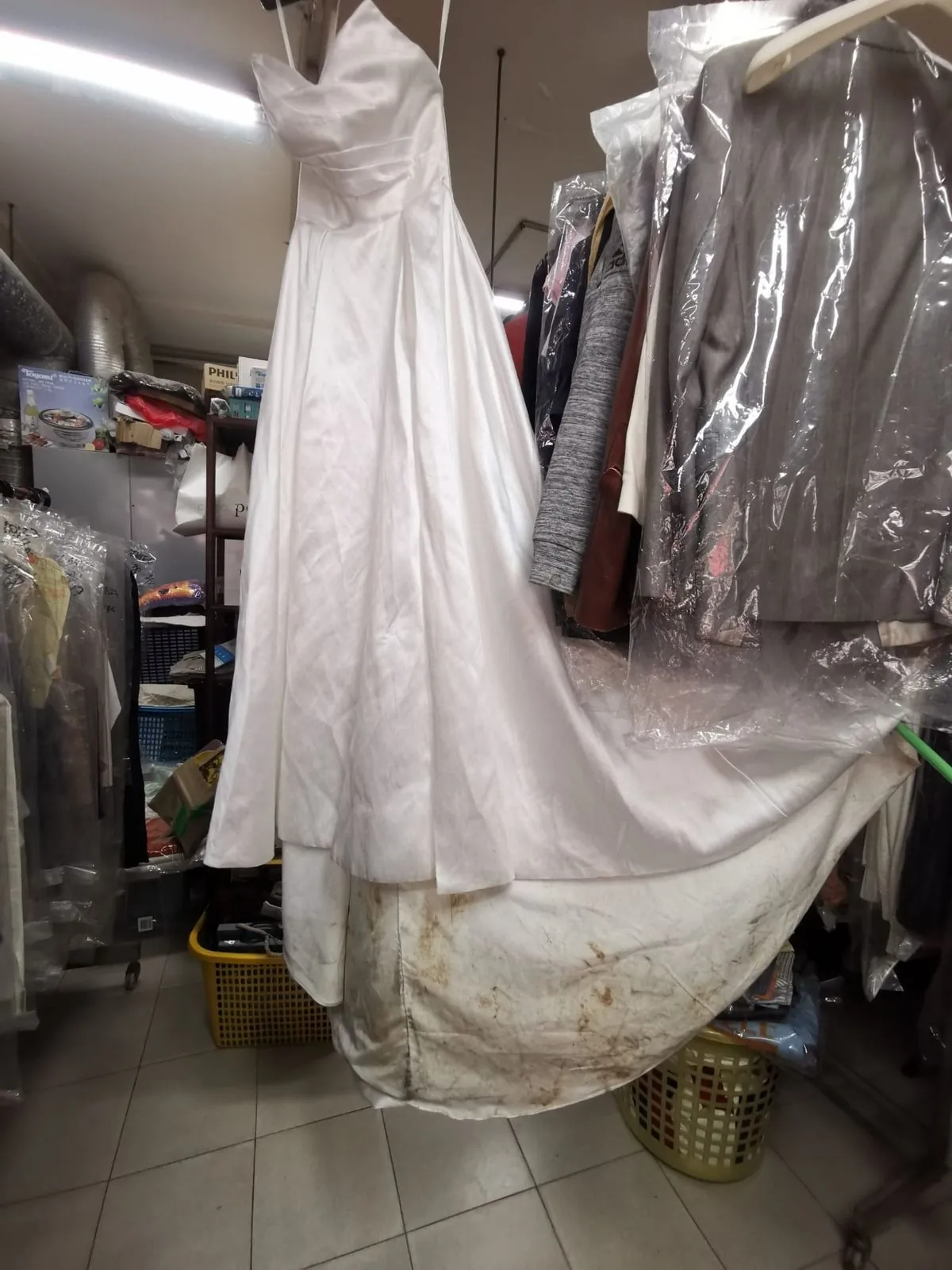
Gown train caked in mud
Heavy mud through a layered train after an outdoor ceremony, released before wet treatment and dried evenly so no watermarks replaced it.
Bridal
Gown train caked in mud
Heavy mud through a layered train after an outdoor ceremony, released before wet treatment and dried evenly so no watermarks replaced it.
 Bridal
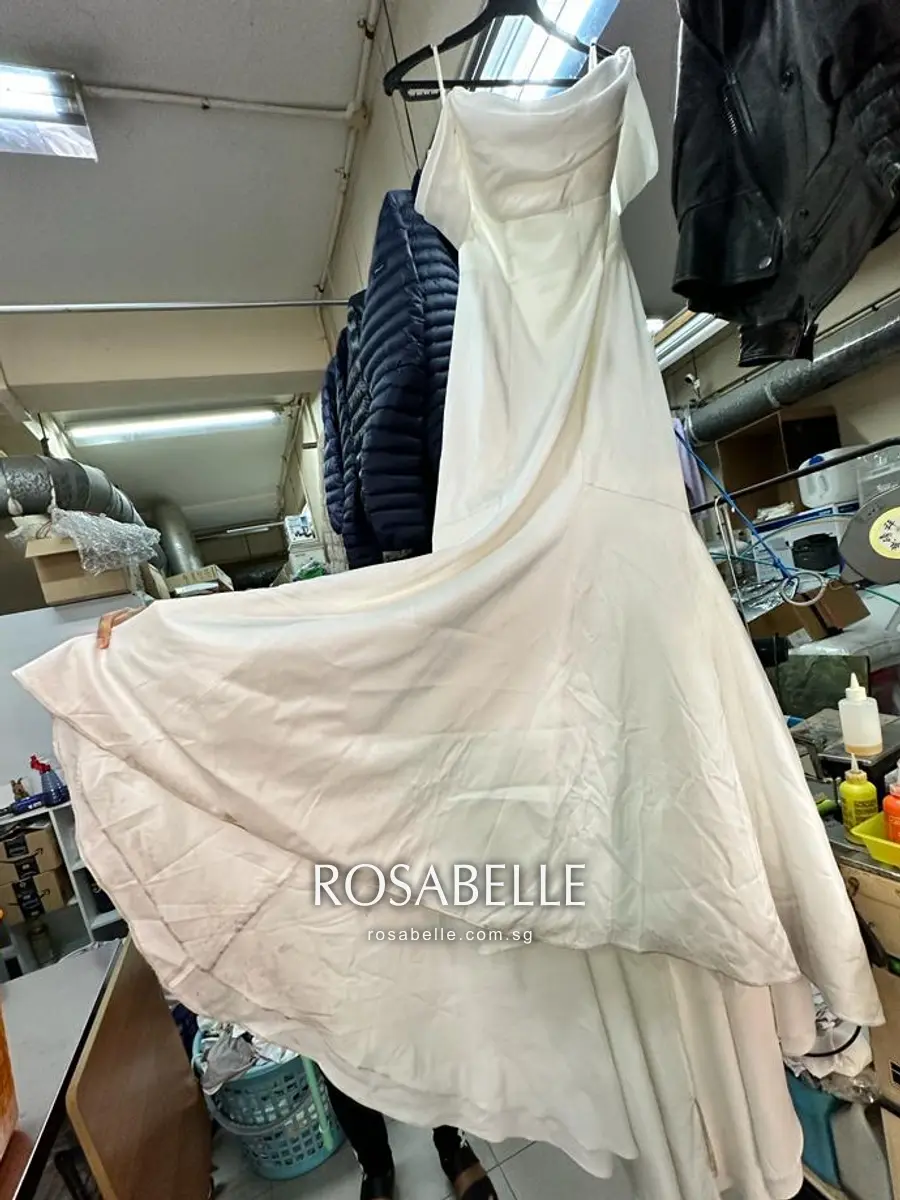
Satin train greyed by one evening
A routine post-wedding clean: the hem and train treated first, then the gown cleaned through and returned white.
Bridal
Satin train greyed by one evening
A routine post-wedding clean: the hem and train treated first, then the gown cleaned through and returned white.
 Bridal
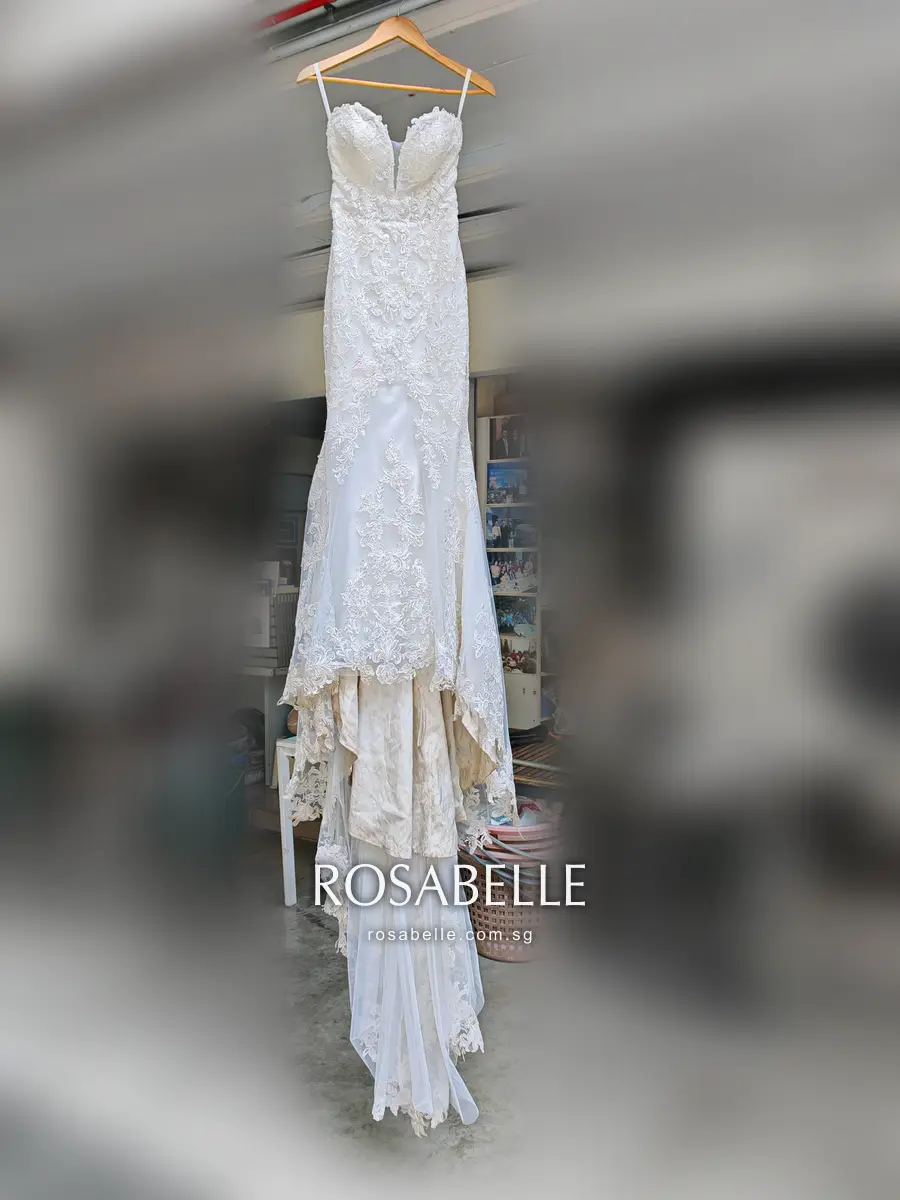
Lace mermaid gown: makeup mark and floor soil
Sequinned lace over tulle: a pink mark lifted from the lace and floor soil from the hem, with the lace and sequins intact.
Bridal
Lace mermaid gown: makeup mark and floor soil
Sequinned lace over tulle: a pink mark lifted from the lace and floor soil from the hem, with the lace and sequins intact.
 Bridal
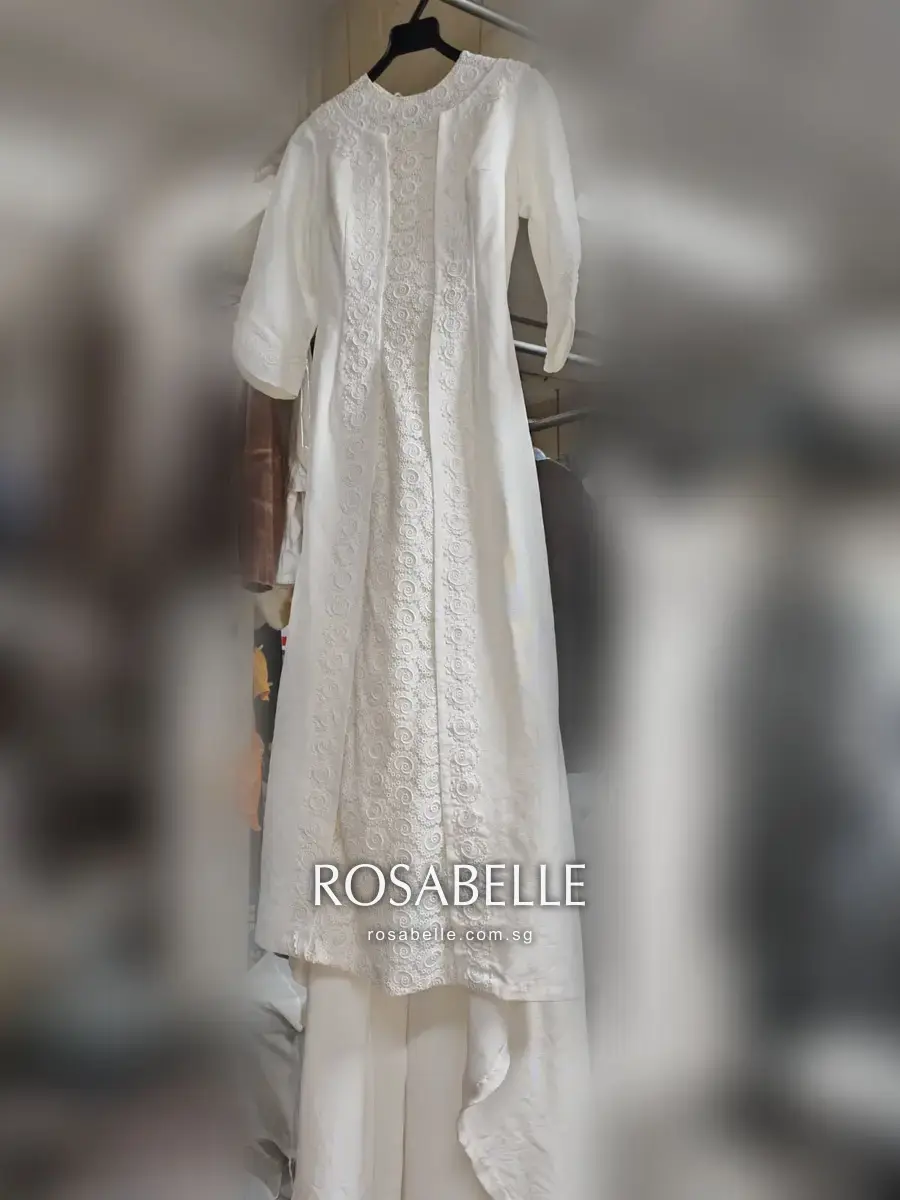
1970s silk gown before storage
A fifty-year-old silk gown with a cutwork lace panel, cleaned with the gentlest method that would work before going back into storage.
Bridal
1970s silk gown before storage
A fifty-year-old silk gown with a cutwork lace panel, cleaned with the gentlest method that would work before going back into storage.
What fabrics are wedding gowns commonly made of?
The outer fabric decides most of the method. These are the ones we see most often in Singapore, and what each one asks for.
Silk
Loses strength with age and marks with water if it dries unevenly. An older silk gown is assessed before anything touches it, worked gently, and dried slowly and under control. Aged silk will not take what new silk takes.
Satin
Shows everything, particularly along a hem. Its sheen is a function of the weave, so abrasion is permanent — soiling is released rather than rubbed out, and the finish is worked back by hand.
Tulle and organza
Open, springy and easy to distort. Soil sits in the mesh rather than on it, and heat or tension flattens the body out of the fabric for good. Both are handled by hand and dried without weight on them.
Chiffon
Fine, slippery and quick to pull out of shape at a seam. It takes the gentlest method that will actually clean it, worked flat, and gets its drape back at the finishing stage rather than under a press.
Lace and cutwork
Only as strong as the threads bridging its holes. Lace is worked by hand instead of agitated, and cutwork panels are supported while wet. Applied lace also has to be checked for adhesive, which some solvents will release.
Beading and sequins
The most common reason a gown cannot go through a standard process. Beads may be glued rather than stitched, sequins can be solvent-sensitive and dull or dissolve outright, and metallic threadwork tarnishes. All of it is tested first and hand-finished after.
Boned and structured bodices
A structured bodice is several layers stitched over boning channels. It is cleaned so the bodice keeps its shape and the boning stays where it was set, and it is finished by hand rather than under a flat press.
Embroidery, metallic thread and appliqué
Metallic threadwork tarnishes, and the couching stitches that hold it down are fine. Appliqués may be glued as well as stitched, and some solvents release adhesive. Each is tested on a hidden area first and finished by hand so the work keeps its relief.
Veils
A veil comes in with the gown more often than not, and it is a separate job. Tulle holds a crease and takes a mark from a single handling, so a veil that has been folded into a box since the day usually needs relaxing as much as cleaning. Cathedral and chapel lengths pick up the same floor soiling along the trailing edge that a train does, and for the same reason.
Beaded, crystal-set and embroidered edges are what decides the method. Crystals are frequently glued, edge embroidery can be metallic, and a scalloped lace border is fragile enough to be supported by hand throughout. A veil is finished flat or hung depending on how it was made, so that it falls rather than hangs stiff.
Veils are quoted after inspection, alongside the gown. Length, layer count and the amount of applied work vary far more between veils than between gowns, so there is no useful single price to publish — bring it in with the gown and both are assessed together.
Wedding kua and ma kua, sari, lehenga, sherwani and cheongsam
Not every bride in Singapore marries in white, and traditional bridalwear is not a lesser version of the same job — in several respects it is harder. A Chinese wedding kua (褂裙) carries dense couched gold and silver threadwork over a silk ground. The metallic thread tarnishes, the couching stitches holding it down are fine, and the ground fabric can move independently of the work sitting on it. It is cleaned around the embroidery rather than through it, and never pressed flat across the goldwork. The ma kua (馬褂) worn by the groom is handled the same way wherever it carries the same metallic embroidery.
The sari or lehenga worn by the bride and the sherwani worn by the groom bring zari, mirror work, sequins and heavy borders. Saris and lehengas are often made on chiffon or georgette with almost no strength of their own. Dye bleed is the first thing tested for, because saturated reds and pinks are common and a bleeding dye finds every pale part of the garment. Pleats and the pallu are finished by hand.
A cheongsam or qipao is a fitted garment with a structured mandarin collar, piped edges and knotted pankou fastenings. Collar and piping hold their shape only if they are supported through cleaning and finishing, and pankou knots crush easily. A full bridal kua, ma kua, sari, lehenga or sherwani is quoted after inspection, like a gown.
Beaded and embroidered pieces of any tradition get what a beaded ballgown gets: tested first, cleaned piece by piece, finished by hand.
Cleaning before long-term storage
We do not sell boxed preservation, and that is a position rather than a gap. Every gown is cleaned, finished by hand and returned in a plastic cover sealed top and bottom, ready to hang. That cover is for the journey home. For storage, the gown should come out of it.
The reason is humidity. Singapore's relative humidity averages over 80 per cent and runs above 90 per cent before sunrise. Mould growth increases in vigour above 75 per cent and becomes strongly active above 85 per cent, so an ordinary wardrobe here sits in that range for much of the day. The damage that ruins a stored gown is also invisible on the day it goes in: perspiration, body oils, perfume and sugar from a spilt drink can dry colourless, then oxidise over the years into the yellow and brown marks people put down to age.
A sealed box stops none of that. It traps whatever moisture was in the fabric and the packing when the lid went on, and moisture held in a sealed container is how mildew starts. Cardboard brings a second problem in this climate: in tropical conditions cockroaches are drawn to the corrugations in cardboard and silverfish feed on starchy paper, clutter gives pests shelter, and soiled silk and cotton are more susceptible to pest attack. A box cannot be inspected once it is shut, so nobody sees any of this until it is opened.
How we suggest keeping a gown here: cleaned first, then out of plastic and into a breathable cotton cover, in a dry, dark wardrobe with air moving through it. Most gowns can hang, with the weight supported so the shoulders and seams are not carrying a heavy skirt or a long train. A heavy or heavily beaded gown is better laid flat and unsealed, with as few folds as possible. Look at it now and then, and have it cleaned again before the next long spell in storage rather than only the first one. A 1970s silk gown brought in for a routine clean fifty years on is what that looks like done right.
- Meteorological Service Singapore: Climate of Singapore (mean annual relative humidity around 82 per cent)
- Canadian Conservation Institute: Agent of deterioration: pests (mould above 75 and 85 per cent relative humidity; soiling and pest attack on silk and cotton; clutter as shelter)
- Smithsonian Museum Conservation Institute: Climate and textiles storage (cockroaches and cardboard corrugations, silverfish and paper, in tropical climates)
- University of Nebraska-Lincoln Extension, G1820: Care of Quilts: Storage and Display (moisture trapped in sealed plastic bags and mildew)
What we do not promise
Cleaning itself carries risk, and it is worth saying plainly: a stain can quietly weaken fabric that looks sound until it is agitated. Every case in our journal is a record of one gown rather than a promise about the next. What we will commit to is inspecting the gown properly, telling you honestly what is achievable before we start, and not proceeding until you have agreed to it.
In their words
What customers say
"I laundered my 40 year-old Wedding Dress, which my younger daughter had altered for her wedding earlier this year, together with her sister's very long veil with crystal embroidering. More recently, I had laundered two, very old and delicate Christening Gowns. One was handed down through 2 generations and the other was purchased in a vintage shop overseas. They were worn by twin babies, 35 years ago. The yellowing on the christening gowns, from age and poor storage, was completely removed by the launderers. A very big thank you to the cleaning technicians and staff of Rosabelle Launderette"
"Gown was done faster than expected and came out whiter than white! Appreciated Joyce's attention to detail in not stretching the delicate fabrics of the gown, and folding it up nicely for me. A fuss free experience, would come again (:"
Common questions
Frequently asked
How much does wedding gown dry cleaning cost in Singapore?
At Rosabelle, a routine wedding gown clean starts from $190 and rises with construction and soiling: a simple silk slip is a different project from a heavily beaded ballgown with a long train. Restoration of set yellowing, rust or storage staining is priced after inspection. Unstructured wedding dresses are $90, evening dresses $45 and tuxedos from $40. The final price is confirmed after inspection, before any work starts.
Why does gown cleaning cost more than a normal dress?
A gown is several garments stitched into one: an outer fabric, a lining, a net or interlining and often a boned bodice with hand-applied beading, and the method has to suit the most fragile of them. The hem and train are treated as a separate job, stain work is done in stages, a large skirt is dried under control and every gown is finished by hand. Restoring set staining typically takes three rounds of treatment or more, with each gown treated on its own by a specialist. The price reflects those hours of hand work on a piece that cannot be replaced.
How long does wedding gown cleaning take?
Five working days and upwards for a routine gown clean, depending on the complexity of the gown and the scope of the work: a simple silk slip is a shorter job than a heavily beaded ballgown that needs hand-finishing throughout. Restoration work, such as lifting yellowing or treating rust on an older gown, typically runs three weeks and up. We'll give you a timeline once the gown has been inspected.
How soon after the wedding should the gown be cleaned?
Within two weeks, ideally. Champagne, perspiration, body oils and makeup can dry colourless and then oxidise into yellow marks over the following months. The sooner a gown comes in, the less time those residues have had to set into the fibre.
Can old yellowed gowns be restored?
Yellowing in a stored gown comes from perspiration, skin oils and drink splashes that went on invisibly and oxidised over time; in older gowns the discolouration has travelled into the fibre itself. An ivory Vivienne Westwood gown we treated went back to an even ivory after repeated controlled treatments. Fibre, the age of the yellowing, earlier cleaning and the gown's trims all change the work, so we assess each gown and say what we expect before any work starts. Complete removal is possible on some gowns but cannot be guaranteed.
Can rust stains be removed from a wedding dress?
Rust spots are iron oxide picked up from a metal fitting, a hanger, a pin or the water, and they do not respond to the treatment that lifts oxidised perspiration, so they need their own. Chlorine bleach sets a rust stain rather than lifting it. On an ivory Vivienne Westwood gown, the rust spotting along the hem was treated separately from the yellowing and came out. The fibre, how long the rust has sat and whether it has already been bleached change the work, and complete removal is possible on some gowns but cannot be guaranteed.
Can mud be removed from a wedding gown train?
Mud behaves like two stains: mineral soil that abrades the fibre if it is rubbed, and organic matter that bonds and yellows if it meets heat too early. On a gown brought in after an outdoor ceremony, with mud ground into the train and underlayers, the dried soil was released before any wet treatment, the organic staining was treated in stages and the layered skirt was dried under control, and it went home white. The amount of mud, the fabric and anything already tried at home change the work, so each gown is assessed first. Complete removal is possible on some gowns but cannot be guaranteed.
Can you clean beaded, sequinned or lace wedding gowns?
Yes. Beads may be glued rather than stitched, some sequins are solvent-sensitive and can dull or dissolve, and lace is only as strong as the threads bridging its holes, so trims are tested on a hidden area before the method is chosen. Lace is worked by hand rather than agitated, and the gown is finished by hand so embroidery keeps its relief. We check trims during assessment and flag the ones at risk where we can, but not every weakness shows beforehand.
Do you clean vintage or long-stored wedding gowns?
Yes. Silk loses strength with age, so an older gown is assessed before anything touches it and cleaned with the gentlest method that will actually clean it. A 1970s silk gown with a cutwork lace panel, brought in for a routine clean before going back into storage fifty years on, is one documented example. Where a stored gown has yellowed or spotted, the work becomes restoration and is priced after inspection.
Do you offer boxed preservation?
No. Every gown is cleaned, finished by hand and returned in a plastic cover sealed top and bottom for the journey home, and we do not seal gowns into boxes. In Singapore's humidity a sealed box holds moisture against the gown and gives insects shelter, and it cannot be inspected once it is shut. The cleaning before storage is what protects a gown; the box is only packaging.
Why not store a wedding gown in a sealed box in Singapore?
Singapore's mean relative humidity is around 82 per cent, and the Canadian Conservation Institute notes that mould growth increases in vigour above 75 per cent and becomes strongly active above 85 per cent. Moisture trapped in a sealed container is how mildew starts, and nobody sees it until the box is opened. Cardboard adds a pest problem: in tropical climates cockroaches are drawn to its corrugations and silverfish feed on starchy paper, clutter gives pests shelter, and soiled silk and cotton are more susceptible to pest attack. That is why we clean the gown thoroughly and recommend a breathable cover where it can be checked.
How should I store my wedding gown after cleaning?
Take it out of the plastic cover, put it in a breathable cotton cover and keep it in a dry, dark wardrobe with air moving through it. Most gowns can hang with the weight supported, so the shoulders and seams are not carrying a heavy skirt or long train; a heavy or heavily beaded gown is better laid flat and unsealed, with as few folds as possible. Look at it now and then, and have it cleaned again before the next long spell in storage.
Do you clean wedding veils?
Yes, and a veil is treated as its own job rather than an extra on the gown. Tulle holds a crease and marks from a single handling, and cathedral and chapel lengths pick up the same floor soiling along the trailing edge that a train does. Crystal, beaded and embroidered edges decide the method, since crystals are often glued and edge embroidery can be metallic. Veils are quoted after inspection alongside the gown, because length, layer count and applied work vary far more between veils than between gowns.
Can you clean a Chinese wedding kua, a sari, a sherwani or a cheongsam?
Yes. A wedding kua (褂裙) and the groom's ma kua (馬褂) are cleaned around their couched gold and silver threadwork rather than through it, and never pressed flat across the goldwork, because the metallic thread tarnishes and the couching stitches are fine. Wedding saris, lehengas and sherwanis are tested for dye bleed first, since saturated reds and pinks are common. A full bridal kua, ma kua, sari, lehenga or sherwani is quoted after inspection, like a gown.
Do you collect wedding gowns for cleaning?
Yes. Gowns can be dropped off at our Orchard or Queenstown outlets, or collected anywhere in Singapore through our pickup and delivery service. Every gown is inspected before any work starts, and the price and timeline are confirmed with you first.